Data Drilling in Web Mining: A Practical Guide
Data Drilling in Web Mining:
A Practical Guide
Introduction:
In today's data-driven world, simply having large amounts of data is not enough. Businesses must be able to dig deeper into their data to uncover patterns, insights, and trends that drive smarter decisions. One powerful technique to achieve this is Data Drilling, especially in the field of Web Mining.
In this blog, we will explore what data drilling is, how it works in web mining, its benefits and disadvantages, and how you can practically implement it using simple tools like MySQL.
What is Data Drilling?
Data Drilling is the process of moving from a high-level summary of data to more detailed levels.
Think of it as “zooming in” on data to understand what’s happening beneath the surface.
For example:
-
You start by looking at total website sales.
-
Then, you drill down into sales by category (like electronics, clothing).
-
Drill further to best-selling products.
-
And even further into regions and customer demographics.
The goal is to find specific, actionable insights from broad data.
What is Web Mining?
Web Mining is the application of data mining techniques to discover patterns from the web — including websites, server logs, user behavior data, and online content.
It includes:
-
Web Content Mining (extracting useful information from web pages),
-
Web Structure Mining (analyzing the links between pages),
-
Web Usage Mining (studying user behavior on websites).
In web usage mining especially, data drilling plays a major role in analyzing and refining user insights.
Data Drilling Flow in Web Mining:
Here’s a simple flow of how data drilling happens in web analytics:
Start with: Total monthly sales
↓ Drill down to: Sales by category (e.g., electronics, clothing)
↓ Further drill down: Best-selling products
↓ Further drill down: Sales by region and customer demographics

Result:
-
Personalized product recommendations
-
Smarter advertisement targeting
-
Better inventory and stock planning
Benefits of Data Drilling:
-
Deeper Insights: Understand hidden trends, not just surface data.
-
Better Decision Making: Specific data helps in smarter strategies.
-
Personalized Experiences: Tailor offerings based on drilled data.
-
Real-Time Monitoring: Make instant decisions from live data.
-
Resource Optimization: Focus marketing and operations on key areas.
Disadvantages of Data Drilling:
-
Data Overload: Too much drilling can confuse rather than clarify.
-
Requires Skill: Analysts must know how to drill correctly.
-
Performance Issues: Large datasets can slow down systems.
-
Privacy Risks: Digging too deep into user data can raise concerns.
-
Tool Costs: Advanced drilling may need expensive BI tools.
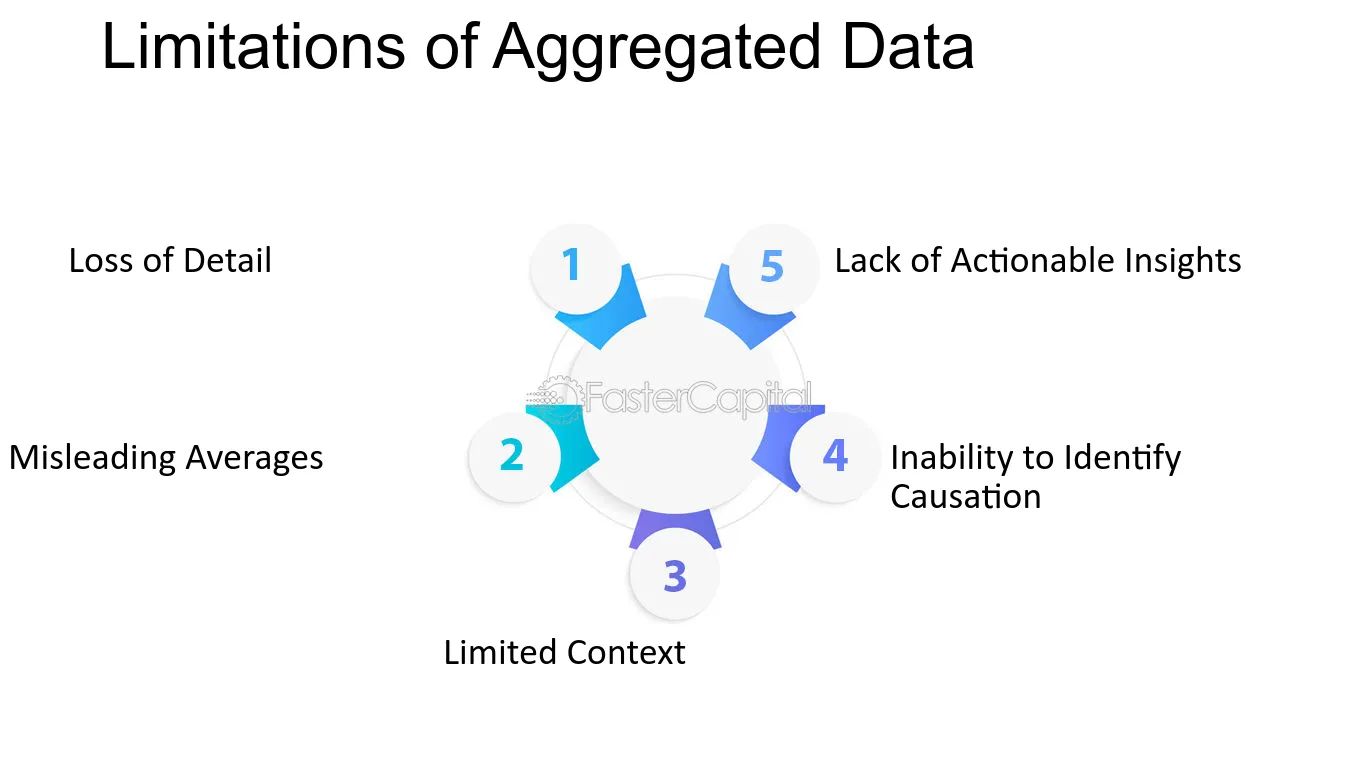
Limitations of Aggregated Data:
Aggregated data is useful for broad analysis but has limitations that can affect its effectiveness. Let’s explore these constraints:
-
Loss of Detail:
Aggregating data can obscure specific trends or outliers, like missing key insights from individual stores or products in regional sales data. -
Misleading Averages:
Averages can be skewed by outliers. For example, including an executive's salary in the average can distort the representation of employee salaries. -
Limited Context:
Aggregated data lacks the context to explain underlying factors, such as why certain countries have higher website traffic without more detailed data like device type or referral source. -
Inability to Identify Causation:
While aggregated data shows correlations, it can’t prove causation. For instance, a correlation between a product feature and high satisfaction ratings doesn’t confirm that the feature is the cause. -
Lack of Actionable Insights:
High-level data may not offer actionable insights. For example, knowing that Instagram has the highest engagement doesn’t reveal how to improve engagement on other platforms without drilling deeper.
While aggregated data offers valuable insights, it’s crucial to drill down into granular details for a more complete and actionable understanding.
Practical Demo: Data Drilling Using MySQL:
We can simulate data drilling easily using MySQL with a simple web analytics database.
Sample Table Structure:
CREATE TABLE web_analytics (
    id INT AUTO_INCREMENT PRIMARY KEY,
    user_id INT,
    page_visited VARCHAR(100),
    category VARCHAR(50),
    product VARCHAR(50),
    region VARCHAR(50),
    age_group VARCHAR(20),
    time_spent INT,
    visit_date DATE
);
Sample Queries for Drilling:
-
View Total Visits:
SELECT COUNT(*) FROM web_analytics;
-
Drill by Category:
SELECT category, COUNT(*) FROM web_analytics GROUP BY category;
-
Drill by Product:
SELECT product, COUNT(*) FROM web_analytics GROUP BY product;
-
Drill by Region:
SELECT region, COUNT(*) FROM web_analytics GROUP BY region;
-
Drill by Age Group:
SELECT age_group, COUNT(*) FROM web_analytics GROUP BY age_group;
Through such SQL queries, we can show how web user behavior is analyzed and how businesses can take decisions based on detailed insights.
Techniques for Drill Drilling Data:
Drilling down into data is crucial for uncovering detailed insights from aggregated datasets. Here are effective techniques to enhance this process:
-
Filters
Filters allow analysts to focus on specific subsets of data based on criteria like region, product, or date. This helps in identifying patterns and trends within a targeted segment. -
Pivot Tables
Pivot tables summarize and group data by categories such as location or time. Analysts can expand or collapse categories, making it easier to explore granular data and uncover trends. -
Data Visualization
Charts and graphs offer a visual representation of data, making it easier to identify patterns, trends, and anomalies. Visualizations like scatter plots can highlight relationships and outliers in data. -
Drill-Through Reports
Drill-through reports enable analysts to navigate from summary data to detailed reports, allowing for efficient exploration of data at different levels of detail without being overwhelmed by large datasets. -
Data Mining
Data mining uses algorithms to detect patterns and trends, revealing insights that may not be obvious through simpler methods like filters or pivot tables. It helps in uncovering hidden patterns, like customer segments, but requires specialized tools and skills.
By employing these techniques—filters, pivot tables, data visualization, drill-through reports, and data mining—analysts can efficiently extract actionable insights and make more informed decisions.

Conclusion:
Data drilling is a simple yet powerful way to dig deep into the sea of information that websites generate daily.
When combined with web mining, it helps businesses understand not just “what” is happening on their site, but also “why” it’s happening and “how” they can improve.
While it has some challenges like data overload or performance issues, the right balance of tools, skills, and ethical practices makes data drilling a must-have skill in modern web analytics.
Key Takeaway:
"Data drilling transforms raw website data into powerful, actionable insights."

Comments
Post a Comment